

DANIELE MELE
It’s great to have you here, Daniele! I’d love to kick things off by hearing a little about your background and what sparked your interest in photography.
My name is Daniele, and I’m 35 years old. I live and work in Italy. My photographic practice explores the relationship between human connections, inner life, and memory. It starts from personal experience, serving as the ground to look at the complexities and vulnerabilities of everyday life, transforming them into something that resonates on a universal level.
I first picked up a camera as a child, initially as a form of play, encouraged by my father, who was deeply passionate about photography. From the very beginning, photography became a way for me to tell stories about the things I loved, the moments that struck me, and the people and experiences that shaped my life. I’ve always been drawn to emotion, to affection, and to those small, fleeting moments of authenticity and spontaneity.
One of the earliest photographs I remember taking was of my paternal grandfather in his yard. I was around four years old and using a small yellow-and-blue film camera that my parents had given me as a gift. That was where it all began.

Do you work exclusively with analog photography, or do you also use digital? If you focus on analog, could you share your development process? For instance, do you develop your own films and print in a darkroom?
For nearly ten years now, I’ve worked exclusively with film. I mainly shoot Ilford HP5, although for a long time I was completely devoted to pushed Kodak Tri-X. I also develop all film by myself. For several years, I also printed in the darkroom, an experience I found both deeply rewarding and formative. More than anything, it taught me to better understand light and contrast in a much deeper way that, in my opinion, is difficult to fully achieve when working solely on a screen. Nowadays, mostly for practical reasons, I scan my negatives. I do very little retouching, and I follow the same mindset and workflow I would use in the darkroom.
Could you share any formal photography education you have received, including any workshops you may have attended?
Photography has always been part of my life, and my first approach to it was very instinctive. As I grew older, I began to engage with photography more consciously, first studying on my own and later through courses and workshops.
Two experiences, in particular, played a pivotal role in my development: a workshop with Michael Ackerman and a master’s program led by Lina Pallotta. Their approach to photography, as well as their guidance, profoundly broadened my perspective, helping me develop a more critical and attentive approach to images. These experiences allowed me to better understand the core of my work and to translate intuitions and emotions into images in a more conscious and meaningful way.
How do you personally define the meaning of photography?
To me, photography is a way of expressing something that would otherwise be difficult to put into words with the same intensity. It is something deeply connected to inner life, to human relationships, and to memory. It allows me to tell a part of the human experience, particularly those aspects that are often overlooked or avoided. It is a way of finding, within everyday, something sincere, fragile, and universal.
Do you recall the moment you first picked up a camera? Can you remember the very first photograph or photographs you captured?
As I mentioned, one of the first photographs I ever took portrays my paternal grandfather in his yard. I was around four years old. I still remember that moment quite clearly, like many of the images I took.


There is something almost romantic that ties me to that particular photo, beyond the fact that it portrays someone very important to me. That roll remained undeveloped for almost twenty years, and, at some point, it was even exposed to light. It was the first roll I ever developed myself, and my grandfather’s image is the only one that survived. The rest is completely blank. I also remember other photographs from that time—mostly my parents, everyday moments, and my first dog. I used to take a lot of photographs as a child.
Congratulations on the release of your first book, Spleen! Did you choose to self-publish it? We’d love to hear more about your publishing journey, including the advantages, challenges, and any obstacles you faced along the way.

Spleen is a self-published book, released in a small print run. The idea was to create something that would immerse the viewer in the core of the work, offering a direct and unmediated experience, yet at the same time deeply intimate.
The book consists of full-bleed black-and-white images with very few visual pauses in between. There are also two short texts, at the beginning and at the end, providing a sense of the overall atmosphere of the work. While I had a pretty clear idea of the concept from the very beginning, the most challenging part was probably the technical side of the production itself. There are so many practical variables involved, not just the choice of materials or the budget. The book is almost sold out now, but I’d really like to make a second edition, maybe even handbound.
When you’re developing a photographic series, do you prefer to create your own sequences, or do you collaborate with an editor or curator for assistance?
I tend to be extremely critical and selective when it comes to my own work. The first stage of editing is something I usually do by myself, working from prints, building some kind of order and meaning, and removing anything that doesn’t really belong to what I’m developing. Then, to step away from any emotional attachment to the images, I also like to engage with editors and curators, mainly through portfolio reviews.

I think that exchange with someone external and experienced is essential. Photography often starts from a very strong emotional impulse, which I think you need to follow, but at some point you also have to step back from it, in order to make sense of that emotional drive and refine the syntax of the work. I believe that’s crucial if you want to develop a body of work that is coherent and specific.
Could you share the inspiration behind your work, Spleen? What were your initial intentions or goals for the project, and what processes did you follow?
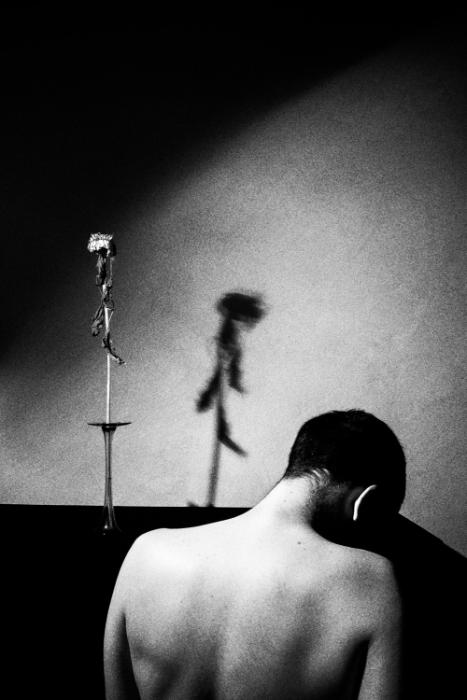
Spleen explores solitude as part of the human condition, focusing on what emerges in the gap between the image we project outwardly and the more private, intimate way we perceive ourselves. The project comes from observing everyday life, and it’s developed around relationships, situations, and places that are part of my own experience. It deals with sense of inner emptiness and the need to give it some kind of meaning, the desire for intimacy, but also the fact that we can never fully reach the other. The entire body of work revolves around that inner space we tend to protect quite carefully, the place we don’t really let anyone into, where we can exist without feeling observed or judged.
Spleen aims to explore these emotional geographies in a more direct way, stripping them away from the dynamics of a constructed and filtered self-representation. In doing so, it seeks to give a visible form to something that is very personal and sometimes unsettling, but still part of a shared experience.


In your work, the boundaries between reality and dreams seem to dissolve. Why are you drawn to exploring this fragile space between consciousness and imagination?
I believe that when we step away, even if only partially, from material reality, setting aside clearly defined notions of time and space, we begin to speak a more universal language and connect with deeper, less rational aspects of human experience. That is precisely where I want my work to lead: to what lies beneath the surface. Not necessarily a secret, but something we carry within us. Something we do not always recognize or fully understand, yet that somehow forms part of our lives.
The figures in Spleen often appear as fleeting traces of light and shadow rather than solid bodies. What does this visual transformation represent for you?

Spleen is a nocturnal work, both in its intentions and in its execution. It reflects a physical and psychological wandering, where desires, fears, and obsessions rise to the surface. It is as though everything emerges from a profound darkness, as though the images were echoes of a hidden dimension. I think of it as the gaze of a traveller wandering, somewhat disoriented, through an unfamiliar city, gathering impressions of everything that surrounds them. The figures are part of this experience, and they serve as a means of giving voice to the elusive nature of inner life. This is why they appear as hints of light, as suspended figures, as presences untethered to any clearly defined time or place.
What tips do you have for aspiring photographers or artists just starting out in photography?
First of all, it takes a great deal of dedication—and at times a certain degree of self-sacrifice—in what you do. After all, “art is a jealous lover.” It is also essential to work with genuine passion, responding your own calling rather than trying to imitate someone else’s work or, even worse, follow passing trends.
Then there’s study and exchange, which I believe are fundamental. This means engaging with painting, the history of photography, and art in general, not just with the technique. And you also have to be open to dialogue, accepting, and almost seeking out constructive criticism. The kind that can knock you down at first but ultimately helps you grow. And finally, but mostly important, you need to live. Look at the world, listen to people, take in what surrounds you. Then, take a position and choose to tell a story.
Thank you again for participating in this interview, Daniele. It’s been a pleasure!
Thank you!
All Images & Video © Daniele Mele

